
If you’re reading this, you probably believe you’re failing, and you’re right. You probably also think failing is a problem and is making you behind in life. Me too. But, failing vs not failing isn’t the problem, perfection is.
Why? Because perfection fuels fear of failure. Perfection convinces you that for permission to take up space, you must provide exceptional value. Failure says, I’m taking up space for my actions and if it doesn’t produce the results I want, I’ll learn and keep going.
*Disclaimer* I am not a health professional. The following information is based on my personal experience and should not be taken as medical advice or theraputic advice.
Perfection is an illusion. Aka a really pretty lie.
No one can be human and be perfect. The only one to ever do it came, went, and lives forever and that’s Jesus. So, while it is desirable to resemble the life of Jesus, it is impossible to expect to do what no man could –be a perfect sacrifice. You don’t need to do it, just thank him for doing it for you and live knowing you will die.
You don’t know how much time you have, and every day you are alive, you are one day closer to the end of your life. So why spend your time focused on impossible, invisible normality standards? I don’t know what that answer is for you, but for me, it was all about image and success.
Before 21, I spent most of life focused on how to fulfill and anticipate the needs and desires of others. I believed that if I could exceed the extraordinary, eventually, I would reflect the image of success. So, I worked my behind off, spending 12+ hours doing, moving, sharing, always on the go and always achieving. Yet, no GPA, job, or accomplishment could live up to the fabricated reality I was chasing.
Perfection left me bored. Very, very bored.
So, I retired (mostly because saying I “gave up” hurt my ego too much at the time). But don’t worry, I made sure to throw myself a retirement party. Yes it was by myself and consisted solely of worship music and journaling, but world-changing celebration doesn’t always need streamers or confetti. Quite the opposite, this quiet moment, left the performance behind and pushed me to envision my next steps without the noise.
In the foreign silence, loneliness, and shock that I was really doing this, I realized the following:
My greatest enemy is perfection. My devotion to perfection has fueled my idolatry of success, my dependence on motivation has excused my inability to practice discipline, and my craving for validation has allowed fear of failure to murder my dreams.
I am not my greatest enemy. My inability to find myself because of the possibility that it won’t be accepted by others, that is my greatest enemy. Fear. Fear murders the opportunity for belief to transform the imagination into reality.
Deep, right?
It’s funny how truth reveals itself in the quiet just like God shows up in a still small voice. But, this information completely contradicted every principle I operated my life on. So, what was I supposed to do now?
And this is where I missed the point, but you don’t have to. I fell right back into my old patterns, trying to use old methods on new information. Trying to put new wine into old wine skins. And as Jesus explains in Mark 2:22, it doesn’t work.
I created brand new routines and habits like waking up at 5 something a.m., creating a detailed list of tasks to complete and was angry with myself when I didn’t get it right. I met vulnerability with condemnation instead of grace.
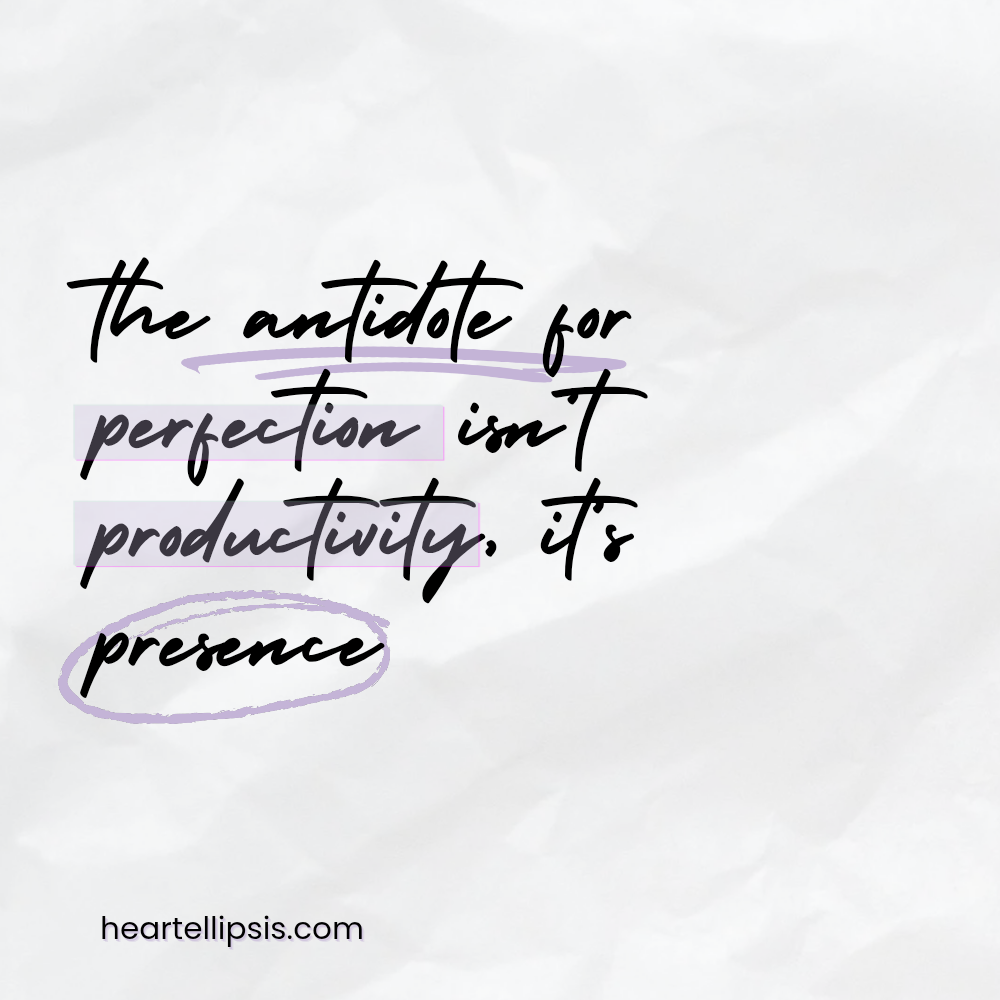
The antidote for perfection is not productivity, it’s presence.

You can certainly go cold turkey and create a detailed schedule with every habit you wish you had and every challenge you hope to accomplish, but creating an aesthetic life doesn’t equate to a fulfilling one. Aesthetic routines address symptoms that you’re not doing what fulfills you.
An aesthetic is a performance. It is only effective when it looks good to others. Transformation is radical, internal change. It is so potent within you that it involuntarily presents itself to others (regardless of if you want them to see it).
So, how do I retire from perfection?
For me, letting go of perfection was difficult because there was so much good that came from the way I was living. I feared not being able to accomplish amazing things if I didn’t push myself beyond my breaking point. And, I believed failure equated to worthlessness.
But, I didn’t come to these realizations without taking time to pause and take space to face myself. I needed the quiet to hear the internal noise that I had pushed away.
Take some time, in quiet or with a supportive accompaniment (worship music, coffee shop music, etc). You, God, and a processing tool. This could be a voice memo, a journal and pen, a collaging session, whatever gets you thinking about the truth.
If you’re stuck or enjoy a little extra guidance, follow the framework in my free workbook Retiring from Perfection: A 4-step Guide to Unpack What’s Holding You Back.

Step 1: Face the facts
Find the motivation of your perfection. Mine was fear, specifically fear of not meeting others’ expectations. Talk to yourself and God about why your motivator drives you, what makes you keep it around, what it does that you appreciate, and how it serves you. Acknowledge:
- I pursue perfection to ______________.
- ____________ allow(s) me to ___________. What does/has [my motivator] allow(ed) me to do?
- I have achieved _________ in pursuit of perfection. Or What have I achieved in pursuit of perfection?
- How does [my motivator] serve me?
Step 2: Face your feelings
Typically, we do things because they make us feel good. Even if it’s just for a little bit and hurts us long-term. And a lot of the time, we avoid facing undesirable feelings because who wants to feel bad? But being dishonest about how you feel, makes it 10x more difficult to address the behaviors that are producing those feelings. So take space to get emotional. Cry, yell, laugh, do whatever you need to be transparent with yourself and God about how perfection makes you feel. Ask yourself:
- How do I feel after I’ve accomplished something perfectly? Note: This is not when others are celebrating you or you receive the good news. (We’re looking for what happens after the dopamine and serotonin rush is gone).
- What am I afraid will happen if I am not perfect?
- What is failure to me and why do I avoid it?
Step 3: Create a new motivator
Now that you know what fuels your perfection, you can decide what you want to fuel your action. What will you align your practices with? When you want to resort back to old patterns for those feelings we identified in Step 2, what will encourage you to stay disciplined. This could be a phrase, a goal, an intention, scripture or another clear-focused statement to guide you. Investigate:
- Why is perfection no longer serving me?
- Why do I desire to retire from perfection?
- What does life look like when I have permission to fail?
- What have I stopped myself from trying because I fear failure?
Step 4: Build a support system
Perfection is isolating. We keep our creative process to ourselves so our results leave a greater impact on our audience. It also acts as a shield so no one knows if or when we mess up. So, it’s time to let people in. Recognize:
- Who can I connect with to hold me accountable?
- Don’t forget your girlfriends. Find an accountability partner, Bible study group, or other peer that you trust and feel comfortable opening up to and going on this journey with.
- Who can I talk to when I need to work through the big scary stuff?
- This could be a mental health professional, a pastor, a mental coach, a mentor. Anyone who is equipped to support you through things that are difficult to unpack.
- How can I offer myself grace as I learn to be okay with failing?
- Make a list of statements, affirmations, activities, or other tools to be kind to yourself when you otherwise would have condemned yourself.
- Create a collection of scriptures to remind you of God’s love and grace for you.
You can do this. Failing is an opportunity to learn, grow, and transform your wildest dreams into reality. You don’t need to be perfect to be loved. Breathe, feel, live, and connect with others. You have a purpose and it does not need to be aesthetically pleasing to be extraordinary.